
After restoring the monarchy in 1953, the Shah, to his credit, continued the progressive reforms started by Mossadegh. As part of his White Revolution, the Shah broke up large estates and gave land to small farmers, started a school meal program for poor children, built new universities, gave women the vote, and modernized Iran’s infrastructure and military, all paid for with oil revenues that increased six-fold during his reign. At the same time, the Shah had a huge ego and sense of entitlement. In 1967, he crowned himself Shāhanshāh, the “Emperor,” and in 1971 celebrated year 2500 of…
Do you want Search?

Post 10. Iraq: 1963 CIA Coup and the Genesis of Saddam Hussein
[Featured Image: Karim Sahib / Getty] Iraq, from the Arabic “araqa,” meaning “deeply rooted, well-watered,” did not come into being until the end of World War I, courtesy of Sykes – Picot, which created the British Mandate of Mesopotamia. But truth be told, Iraq should not even be a country, and making it one would, along with CIA meddling and two U.S. wars, eventually cause misery for millions. Mesopotamia, Greek for “the land between the rivers,” the Tigris and Euphrates, is often called the “cradle of civilization,” the birthplace of Bronze Age settlements dating back to 10,000…

Post 11. America’s Unprincipled Role in Saddam Hussein’s War on Iran 1980 – 1988
Featured Image: E. Ou / ICRC / Getty Images September 22, 1980, Iraq invaded Iran, starting a horrific war marked on both sides by missile attacks and artillery barrages on cities, and by Iraq’s use of chemical weapons. When it ended eight years later, as many as a million combatants and civilians had been killed and hundreds of thousands more wounded and maimed. Two big questions. Why did Iraq invade Iran? And, more troubling, why and how did the U.S. help Saddam Hussein finance and fight that war? Saddam Hussein claimed that Iran provoked the war…

Post 12. 1978 – 1989: Afghanistan, Soviet Union and Jihad
Featured Photo: Sovfoto Notwithstanding the idyllic Kabul described in the opening pages of The Kite Runner, an island of privilege and modernity with prosperous businessmen in western suits, educated women with their hair uncovered, meticulously kept parks, even an American school, pre-1978 Afghanistan was mostly a very backwards place, with 90 percent illiteracy, 25 percent infant mortality, life expectancy 40 years. The government was a constitutional monarchy, and Mohammed Daoud, a member of the royal family and first President of Afghanistan, famously said, “I feel happiest when I am lighting American cigarettes with Russian matches.” He had no clue it would turn out to…

Post 13. Iraq’s 1990 Invasion of Kuwait
The glorious tale has been told and retold. On August 2, 1990, Iraq invaded and annexed its oil-rich neighbor, Kuwait. Just over four months later, on January 16, 1991, a U.S.-led multi-national coalition launched a massive assault, Desert Storm, first from the air, pummeling Iraqi infrastructure and air defenses for more than a month, and then on February 24, unleashing a lightning ground war that in just 100 hours sent what was left of Saddam’s forces fleeing back to Bagdad on the “highway of death.” Liberating tiny Kuwait from big bad bully Saddam Hussein. Shock and awe.…

Post 14. Desert Shield and the Selling of the First Gulf War
August 2, 1990. Iraq invaded Kuwait. Four mechanized divisions of Iraq’s elite Republican Guard, supported by helicopter gunships, rolled down Highway 80, all six lanes of it, and Iraqi commando units assaulted Kuwait City from the Gulf. Despite months of saber-rattling by Saddam Hussein, Kuwaiti military units were not on alert and many soldiers had taken leave to get away from the searing August heat. Although the Emiri Guard fiercely defended Dasman Palace, the royal residence, and a Kuwaiti tank and artillery battalion inflicted heavy losses on an Iraqi tank column at al-Jahra, the Battle of…
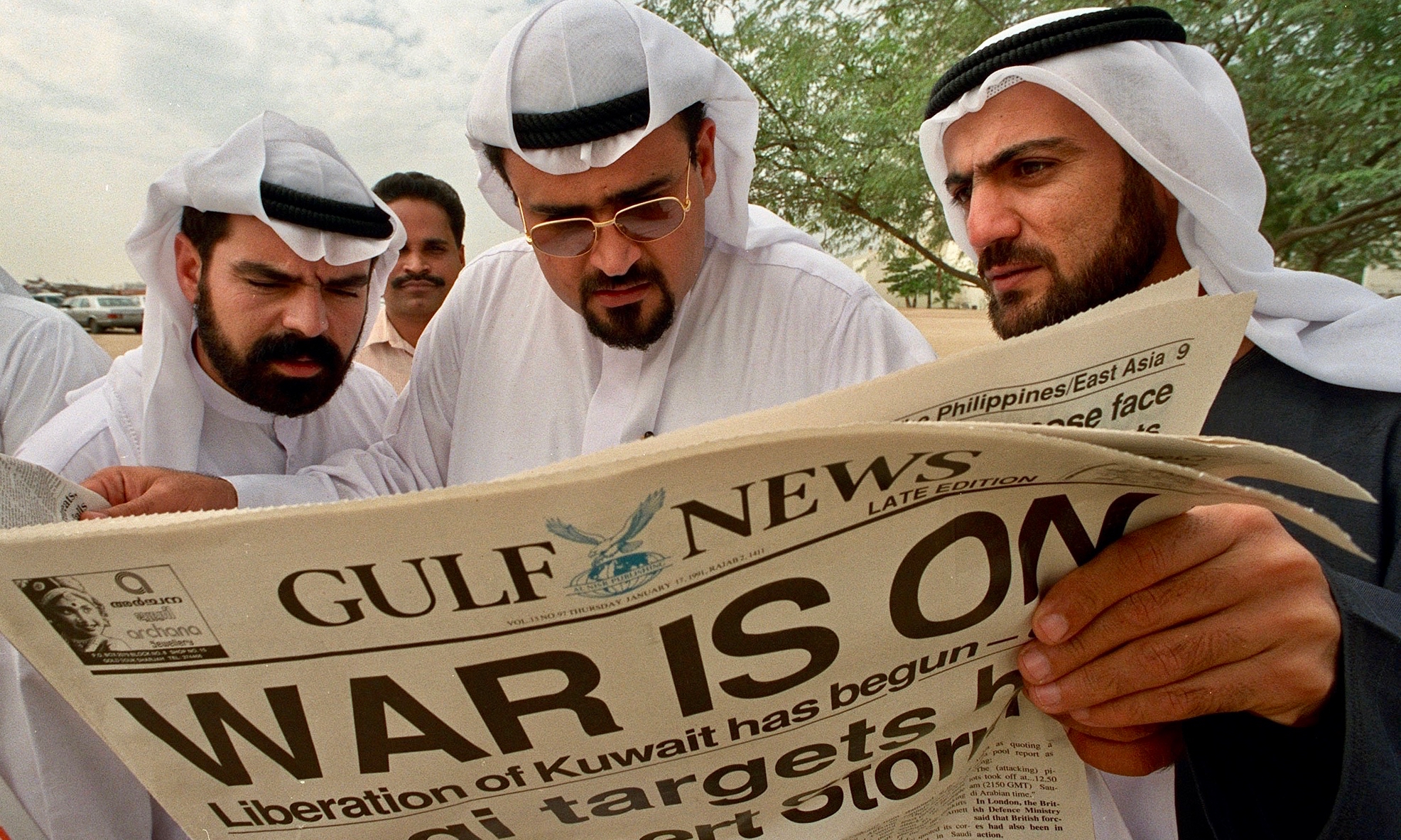
Post 15. Desert Storm – The Air War
[Featured Image: Reuters] On the January 15, 1991 deadline for unconditional withdrawal, Saddam’s forces in Kuwait were still dug in, and two days later, January 17, the U.S., with its coalition partners in tow, went to war against Iraq. One hour before the air assault was to begin, James Baker got a call from the new Soviet Foreign Minister, Alexander Bessmertnykh, who relayed a personal request from Mikhail Gorbachev to delay the bombing and give him time to make one last appeal to Bagdad. Baker said, “Well, no, there’s too much that’s been put on the…

Post 16. Desert Storm – The Ground War
[Featured Image: Greg Young / AP] The Coalition’s bombing campaign ended February 23, 1991. It was the eve of a massive ground assault, code name “Desert Sabre,” to drive Saddam Hussein’s occupying forces out of Kuwait. Saddam called it the “mother of all battles,” which he borrowed from the Quran. Mecca is “Umm al-Qura,” the “mother of all cities.” But it really wasn’t much of a battle, more what the Brits called a “grouse shoot,” although that puts it much too quaintly, it was, in a word, a massacre. On paper, Iraq’s military was impressive, the…

Post 17. Desert Storm – Aftermath
[Featured Image: Sebastião Salgado] First week of March, 1992. After 37 days of strategic bombing and a blitzkrieg 100-hour ground war, Saddam’s forces were utterly defeated and out of Kuwait. Mission accomplished. Now what? Seeking a second-term, with the November election only eight months off, George Bush said, “We need to have a clean end. People want that. They are going to know we won and the kids can come home. We don’t want to screw this up with a sloppy, muddled ending.” If only. In fact, Bush, Cheney, Baker, et al., had no real plan…

Post 18. Economic Sanctions on Iraq: Weapons of Mass Destruction
[Featured Image: Joy Gordon] On August 6, 1990, four days after Saddam Hussein’s forces invaded Kuwait, the U.N. Security Council passed Resolution 661 imposing economic sanctions on Iraq, a full-blown trade embargo by all U.N. member states, followed by resolutions for naval and air blockades “to halt all inward and outward shipping.” The 661 sanctions would stay in place for 13 years, until Saddam was removed from power in May 2003. Although in theory allowing food, medicine and “other essentials,” it was effectively a total ban on everything in or out of Iraq, enforced by the…
Recent Comments